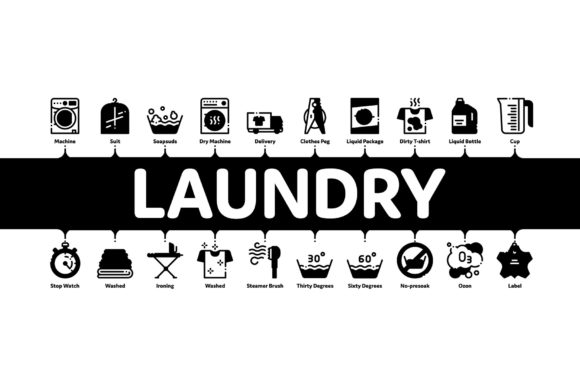
Laundry Service Minimal Infographic: Visual Clarity for Modern Cleaning Businesses
In the competitive landscape of local services, visual communication often determines whether a potential customer engages with a brand or scrolls past. For laundromats, dry cleaners, and on-demand washing apps, the challenge lies in conveying complex service menus quickly and cleanly. This is where the Laundry Service Minimal Infographic becomes an essential asset. Rather than relying on dense text or cluttered photography, these design elements utilize linear pictograms and contour illustrations to create an immediate understanding of services offered.
The shift toward minimalism in service industry marketing is not merely an aesthetic choice; it is a functional necessity. When a user lands on a website or walks into a launderette, they are typically seeking specific information: pricing, turnaround time, and service types. A well-executed Laundry Service Minimal Infographic Web Banner Vector bridges the gap between business offerings and consumer needs, translating operational capabilities into universally understood visual symbols.
The Anatomy of Effective Laundry Iconography
To understand the value of these assets, one must first distinguish between generic clip art and professional-grade linear pictograms. The latter are designed with consistency in stroke weight, corner radius, and negative space. This uniformity is critical when displaying multiple services side-by-side. Whether depicting stain removal, ironing, or dry-cleaning, the visual language must remain cohesive to maintain brand integrity.
Linear Pictograms vs. Solid Illustrations
Minimal infographics predominantly use line art rather than solid fills. This approach offers several practical advantages for digital and print media:
- Scalability: Linear vectors retain crisp edges at any size, from a mobile app icon to a large-format storefront sign.
- Cognitive Load: Outline styles are processed faster by the brain, allowing users to scan service lists without fatigue.
- Modern Aesthetic: Contour illustrations convey cleanliness and precision, qualities directly associated with professional laundry services.
- Customizability: Vectors allow designers to adjust stroke colors to match specific brand palettes without degrading image quality.
When evaluating a Washing Clothes Linear Pictogram set, look for semantic clarity. Does the iron icon clearly represent pressing services, or does it look like a generic household object? Ambiguity is the enemy of conversion. Professional sets ensure that each symbol maps directly to a specific service tier, eliminating guesswork for the consumer.
Strategic Applications Across Digital and Print Media
The versatility of Laundry Service Minimal Infographic assets extends far beyond simple decoration. These visual tools serve distinct functional roles across various touchpoints in the customer journey. Understanding where and how to deploy them can significantly enhance user experience and operational efficiency.
Web Banners and Landing Pages
The Laundry Service Minimal Infographic Web Banner Vector is perhaps the most high-impact application. On a homepage, this banner acts as a visual anchor, summarizing the business’s core value proposition within seconds. Unlike raster images (JPG or PNG), vector banners load instantly and adapt fluidly to responsive layouts. This is crucial for mobile users who may be searching for "laundromat near me" while on the go.
Effective web banners combine iconography with concise typography. For example, a horizontal layout might feature three key icons—Wash, Dry, Fold—aligned with brief service descriptors. This triad structure mirrors the natural reading pattern of left-to-right languages and reinforces the simplicity of the service process.
In-Store Signage and Wayfinding
Physical locations benefit equally from minimal illustration. In a self-service launderette, clear signage reduces staff interruptions and improves customer autonomy. Ironing Contour Illustrations placed near pressing stations provide instant instructional cues, while Stain Removal icons on detergent dispensers guide product selection. Because these graphics rely on shape rather than color alone, they remain accessible to non-native speakers and individuals with visual impairments.
Social Media and Digital Advertising
Platforms like Instagram and Facebook favor visually clean content. A minimalist infographic stops the scroll more effectively than a stock photo of folded towels. Advertisers can use individual pictograms as carousel slides to highlight specific promotions, such as "Free Ironing with Every Dry Clean." The lightweight nature of vector-based graphics also ensures fast ad loading times, which correlates directly with higher click-through rates.
Technical Considerations: JPG vs. EPS Formats
When acquiring or commissioning Laundry Service Minimal Infographic assets, file format dictates usability. Most professional packages include both JPG and EPS versions, each serving different purposes.
- EPS (Encapsulated PostScript): This is the master vector format. It contains mathematical paths rather than pixels, making it infinitely scalable. Designers should always work in EPS when creating new layouts, resizing graphics, or changing colors. It is compatible with Adobe Illustrator, CorelDRAW, and other vector editing software.
- JPG (Joint Photographic Experts Group): This raster format is pre-rendered at a fixed resolution. While convenient for quick insertion into Word documents or basic social media posts, JPGs lose quality when enlarged. They are best reserved for final outputs where dimensions are known and static.
Important Note: Always retain the original EPS files. If your business rebrands or expands services in the future, having editable vectors saves significant redesign costs. Rasterized JPGs cannot be easily modified without redrawing from scratch.
Evaluating Suitability for Your Business Needs
Not every laundry business requires a comprehensive suite of Washing Clothes Linear Pictograms. Suitability depends on service complexity, target audience, and existing brand identity. Before investing in premium infographic assets, consider the following evaluation framework.
Service Complexity Assessment
If your business offers only basic wash-and-fold, a single icon may suffice. However, full-service operations including dry-cleaning, alterations, leather care, and specialty stain treatment demand a systematic visual library. The more diverse your offerings, the greater the need for standardized iconography to prevent menu confusion.
Audience Demographics and Tech Literacy
Younger, digitally native audiences respond well to abstract minimalism. Older demographics or tourists may require more literal representations paired with multilingual text labels. Test icon comprehension with real users before full deployment. What seems intuitive to a designer may be ambiguous to a first-time customer.
Brand Alignment Check
Minimal infographics work best for brands positioning themselves as modern, efficient, and tech-forward. Traditional luxury cleaners emphasizing heritage craftsmanship might find contour illustrations too clinical. In such cases, detailed engraving-style illustrations or photography may better communicate value. Always align visual style with brand personality.
Practical Implementation Guidelines
Maximizing the ROI of Laundry Service Minimal Infographic assets requires thoughtful integration. Below are actionable guidelines for creators and business owners.
- Maintain Consistent Stroke Weight: Never mix icons from different sets. Variations in line thickness create visual noise and undermine professionalism.
- Use Adequate White Space: Minimal icons need breathing room. Crowding pictograms reduces legibility and defeats the purpose of minimalist design.
- Pair with Clear Typography: Icons support text; they don’t replace it. Always include service names alongside symbols unless the context makes meaning unambiguous.
- Test Across Backgrounds: Ensure icons remain visible on both light and dark surfaces. Create inverted versions if necessary for contrast compliance.
- Update Seasonally: Rotate featured icons to highlight seasonal services (e.g., winter coat cleaning or summer linen care) to keep visuals fresh and relevant.
Beyond Aesthetics: The Functional Value of Visual Systems
Ultimately, the Laundry Service Minimal Infographic is more than decorative—it is a functional communication system. In an era of shrinking attention spans and increasing service options, clarity converts. Customers don’t want to decipher complex menus or squint at blurry photos. They want instant confirmation that their specific need can be met quickly and professionally.
By leveraging standardized Washing Clothes Linear Pictograms, Laundromat signage, and Dry-Cleaning vectors, businesses reduce friction at every touchpoint. Staff spend less time explaining services. Websites convert visitors faster. Physical spaces operate more smoothly. The initial investment in quality visual assets pays dividends through improved customer satisfaction and operational efficiency.
Whether you are launching a new app, refreshing a storefront, or optimizing digital ads, prioritize visual clarity. Choose assets that balance aesthetic appeal with functional precision. Remember that in the laundry service industry, cleanliness isn’t just about clothes—it’s about communication. A minimal infographic doesn’t just show what you do; it demonstrates how thoughtfully you do it.