Volcano Infographic in Isometric Style: A Visual Guide for Modern Web Design
In the competitive landscape of digital content, capturing attention while conveying complex information is a persistent challenge. For educators, marketers, and web designers tasked with explaining geological phenomena, disaster preparedness, or metaphorical business growth, standard flat graphics often fall short. The Volcano Infographic, Isometric Style has emerged as a powerful solution, bridging the gap between technical accuracy and aesthetic appeal. This specific visual approach utilizes an axonometric projection to create three-dimensional representations on a two-dimensional plane, offering a unique perspective that enhances user engagement and comprehension.
Understanding the utility of an isometric volcano vector infographic requires looking beyond its artistic merit. It is a functional design asset that serves specific communicative purposes. Whether you are building an educational portal for earth sciences or designing a creative campaign about "explosive" market trends, this style provides depth, clarity, and a modern feel that traditional top-down maps cannot achieve. Furthermore, the availability of these assets in versatile formats like JPG, EPS, AI, PSD, and PNG ensures that creators can integrate them seamlessly into workflows ranging from high-resolution print media to responsive web design.
The Functional Advantage of Isometric Projection
To appreciate why the Volcano Infographic, Isometric Style is so effective, one must understand the mechanics of isometric design. Unlike perspective drawing, where parallel lines converge at vanishing points, isometric art maintains parallel lines throughout the composition. This lack of distortion means that measurements remain consistent regardless of where an object is placed within the graphic. For a volcano cross-section, this is invaluable.
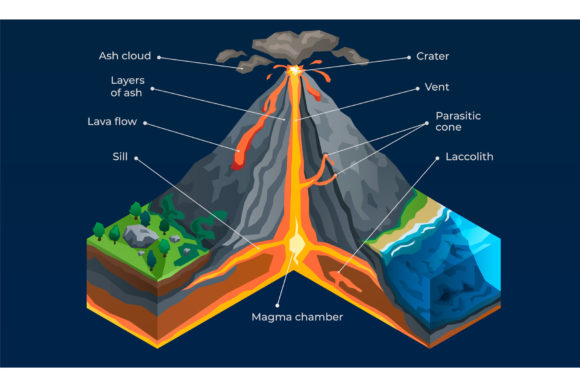
When illustrating internal geological structures—such as the magma chamber, conduit, vent, and crater rim—isometric projection allows viewers to perceive spatial relationships accurately. A flat diagram might require multiple separate images to show surface features versus subsurface activity. An isometric cutaway combines these layers into a single, cohesive visual narrative. This efficiency reduces cognitive load for the audience, allowing them to grasp the connection between underground pressure and surface eruption without mentally reconstructing the 3D form.
Key Characteristics of High-Quality Volcano Vectors
Not all infographics are created equal. When evaluating a volcano infographic for professional use, several characteristics determine its effectiveness and longevity in your design library:
- Layered Organization: Professional vector files (AI/EPS) should have clearly labeled layers. Separating the terrain, lava flows, smoke effects, and text labels allows designers to toggle elements on or off depending on the specific context of the presentation.
- Color Coding Logic: Effective infographics use color semantically. Red and orange gradients typically indicate heat and active magma, while cool blues and greys represent rock strata or dormant states. Consistent color logic helps users intuitively navigate the information.
- Scalability Without Artifacts: Because these are vector-based, they must remain crisp at any size. A high-quality isometric volcano should look sharp on a mobile screen and equally detailed when printed on a large-format poster.
- Editability: The ability to modify shapes and colors is crucial. A rigid template limits utility, whereas a flexible vector asset adapts to brand guidelines and specific educational requirements.
Practical Applications Across Industries
The versatility of the Volcano Infographic, Isometric Style extends far beyond geology textbooks. Its distinct visual language makes it applicable in diverse professional scenarios.
Educational and Scientific Communication
For teachers and science communicators, accuracy is paramount. Isometric vectors allow for precise labeling of volcanic anatomy. Educators can use these graphics to explain plate tectonics, eruption types (effusive vs. explosive), and hazard zoning. The 3D-like quality helps students visualize abstract concepts, making lessons more memorable. In museum exhibits or interactive kiosks, these graphics serve as intuitive wayfinding and informational tools that engage visitors of all ages.
Business Metaphors and Corporate Presentations
In the corporate world, volcanoes are frequently used as metaphors. A "dormant volcano" might represent latent market potential or accumulated organizational stress, while an "eruption" could symbolize a product launch or a viral marketing moment. Using a stylized isometric volcano vector infographic in pitch decks or annual reports adds a layer of sophistication to these metaphors. It transforms cliché business speak into compelling visual storytelling, helping stakeholders visualize risk management strategies or growth trajectories in a tangible way.
Web Design and User Interface
Modern web design favors visuals that break up dense text and guide user attention. Isometric illustrations have seen a resurgence in UI/UX because they feel tactile and interactive. A travel website focusing on destinations like Hawaii, Iceland, or Japan can use these infographics to highlight geological landmarks safely and informatively. Disaster preparedness sites utilize them to map evacuation routes relative to terrain elevation, providing critical safety information in a format that is easier to parse than satellite imagery.
Navigating File Formats for Optimal Workflow
Selecting the right file format is as important as choosing the right image. Understanding the strengths of each available format ensures that the Volcano Infographic, Isometric Style performs optimally in your specific project.
- AI (Adobe Illustrator) & EPS: These are source files. They are essential if you need to resize the graphic significantly, change colors to match a brand palette, or alter the composition. EPS is universally compatible with most vector software, while AI offers native editing capabilities for Adobe users.
- PSD (Photoshop Document): Ideal for raster-based editing. If your workflow involves adding texture overlays, lighting effects, or integrating the volcano into a photo-manipulated composite, a layered PSD provides pixel-level control. Note that resizing PSDs upward will result in quality loss.
- PNG: The standard for web use. PNGs support transparency, allowing the isometric volcano to float cleanly over colored backgrounds or other webpage elements without jagged edges. Always export at 2x resolution for retina displays.
- JPG: Best for quick previews or contexts where file size is strictly limited and transparency is not needed. However, JPG compression can introduce artifacts around sharp vector lines, so it is generally less suitable for final production of line-heavy infographics.
Evaluating Suitability and Limitations
While the volcano infographic in isometric style is highly effective, it is not a universal panacea. Creators must weigh its strengths against potential limitations to ensure it aligns with their goals.
Strengths: The primary advantage is clarity combined with engagement. Isometric views eliminate the foreshortening that can make cross-sections confusing. They also possess a timeless, technical aesthetic that avoids looking dated quickly. Additionally, vector formats future-proof the asset against changing display resolutions.
Considerations: Isometric art can sometimes feel clinical or detached. If the goal is to evoke raw emotional terror regarding natural disasters, a photorealistic image may be more appropriate. Isometric infographics excel at explanation and analysis, not necessarily at visceral emotional impact. Furthermore, creating custom isometric art from scratch requires specialized skills; therefore, relying on pre-made assets means accepting certain structural constraints unless you have the expertise to modify the underlying geometry.
Practical Expectation: When purchasing or downloading these assets, always verify the license terms. Commercial use, editorial use, and modification rights vary significantly between providers. Ensure the asset’s licensing covers your intended distribution channels, especially for commercial web projects or merchandise.
Best Practices for Implementation
To maximize the impact of your Volcano Infographic, Isometric Style, consider the following implementation strategies:
- Maintain Visual Hierarchy: Even in a detailed isometric view, the eye needs a focal point. Use saturation and contrast to draw attention to the most critical data point, whether that is the magma source or a specific hazard zone.
- Pair with Concise Copy: Let the graphic do the heavy lifting. Text annotations should be brief and positioned to follow the natural reading flow of the isometric angle (typically top-left to bottom-right).
- Ensure Accessibility: Infographics are visual by nature, but web accessibility standards require alternatives. Always provide comprehensive alt-text descriptions that convey the same information presented visually. For complex diagrams, consider providing a long-form text transcript or a data table alongside the image.
- Test Across Devices: Isometric details can become cluttered on small screens. Create responsive variations of the infographic, perhaps simplifying the detail level or stacking vertical elements for mobile viewing to maintain legibility.
Ultimately, the Volcano Infographic, Isometric Style represents a convergence of art and information architecture. By leveraging the precision of vector technology and the spatial clarity of isometric projection, creators can transform complex geological or conceptual data into accessible, engaging visual experiences. Whether utilized for academic instruction, corporate strategy visualization, or immersive web design, this format remains a vital tool in the modern communicator's arsenal. Selecting the appropriate file format and adhering to best practices in visual hierarchy and accessibility will ensure that these dynamic graphics continue to inform and inspire audiences effectively.